Its been a while since I made a blog post because unlike most college students that take summer off, I decided to enroll in summer quarter classes. This summer I’m finally finishing up with the infamous anatomy and physiology duo (A&P). Anatomy and Physiology are pre-requisites for many health care programs including the nursing program I plan on applying to this winter. It also happens to be a class that many people struggle with because its a lot of information that you need to know. I wanted to share my experience, as well a my insight and tips while taking these two classes.
WHAT TO EXPECT
First I’m gonna talk about the general class structure. A college will either offer A&P as two separate classes, where you cover all of anatomy and all of physiology separately. Or they will offer it combined into a dual class. When the classes are combined you learn about both A&P together at the same time but you still take two classes (Anatomy and Physiology 1 & 2). My college offered the classes separately. Which means in one quarter I learned all about the anatomy of the human body, and then in the next quarter covered all of physiology.
Both classes require a lot of memorization and grammar building. If you have taken medical terminology then you’ll do well with the basics. I took medical terminology before this class, but if you haven’t, purchasing a terminology cheat sheet for your binder is highly recommended. Understanding medical root words, suffixes and prefixes are important in both classes and in a clinical setting. Its important to pay attention in anatomy since anatomy, biology and chemistry are the building blocks of physiology. In my experience A&P are very workload heavy classes, with homework, case studies, long labs, lectures and exams.
Its important to take A&P seriously. There were many people in my classes who dropped out within the first few weeks of taking A&P because they got too far behind or underestimated the course. Take it seriously from day one. Some sections will be harder then others both in workload and what you’re able to easily grasp. A&P is the foundation of health care education.
WALKING IN BLINDLY
I first took Anatomy (BIOL231) in Fall of 2023 accompanied by Intro. to Psychology (PSYCH 100). I was recently graduated from high school and it was my first college quarter outside of running start. I didn’t have any friends at the time who had taken the class which meant I was walking in blindly. I walked into lab that first day and was instantly taken back by how much knowledge we were already suppose to know. Our class introductions included us stating our names followed by a anatomical terms and direction quiz by the teacher in front of the class. Some students seemed to know the answers to all the questions the professor asked, she addressed the class stating that, ‘some student may know the material better because this isn’t their first time taking the class’. Each lab got harder after that. In my first anatomy class our grade was heavily based on our exams we had throughout the quarter. There were three types of exams:
Lecture Exams : on paper with scantrons and usually consisting of 50-100 multiple choice questions.
Lab Exams : we would number our papers 1-65 and the professor would go around pointing to specific parts on models; most questions had multiple parts (example: what is this tract? how many sphincters does it have? are they involuntary or voluntary? what tissues lines it?) .
Dissection Practical Exams: throughout the quarter we would skin and dissect a deceased cat and then would have muscular and anatomical exams where we would have to point out different parts of our dissected cat to the professor one on one.
In the end I ended up getting a failing grade the first time I took anatomy. I fell behind with the material and didn’t have the motivation to keep up. I was so distraught with the class that I didn’t even show up to the final exam. This meant I had to retake the class.
RETAKING ANATOMY / WHAT IVE LEARNED
I retook Anatomy (BIOL231) in SPRING 2024 and had a much better outcome. In this class, we still had the same exam structure however it was weighted less for our final grades. Another factor that changed how well I preformed in the class, was that I now had a lab partner I knew and could study with. We would usually tackle 2-4 chapters per week. Each chapter had two online homework assignments and one online timed exam. Each unit had a online timed lecture and lab exam. This was followed by in person labs, a lab text book with pages assigned as homework, and then the in class unit exams. In my class before going over the human systems, we went over anatomical terms, directions (surface and regional anatomy) and histology. Histology was my least favorite part of this class. Some classes will expect different levels of understandings of all the tissues in the human body. In my class we had to know all the tissues, where they were located, what they did, and how to identify them given a microscopic sample. The majority of the quarter anatomy covers all 11 of the human systems usually in this order: integumentary, muscular, skeletal, nervous, cardiovascular, respiratory, lymphatic, endocrine, urinary and reproductive. These were the “units” of the class.
Just like the previous class we had dissections in lab. In more detail, we were given in class lab time, a scapple and some bone saws. For the first half of the quarter we focused on skinning the cat and locating all of its muscles. The muscles would be torn away from soft connective tissue. We dissected both the surface and deep muscles of the abdomen, arms, legs, back, and ankles of the cat. The other half of the quarter we spent on the general anatomy of the cat. Focusing on the brain, heart, lungs, all the organs of the abdominopelvic cavity and arteries. The first practical exam consisted of flash card, which when picked had a list of muscles you had to correctly identify on your cat. You were graded on how well you were able to direct the muscle out and if you correctly identified it. The second exam also had flash cards, which when picked had a list of orangs or anatomical features of the cat you had to find. Overall I’ve found that the professor and class set up really affects how well you learn the martial. Anatomy is by far (in my opinion) harder then physiology because there is a lot more you have to mesmerize and it feels like you’re pulling concepts out of thin air. There is very few building blocks that can prepare you for this class.
THE BETTER HALF -> PHYSIOLOGY
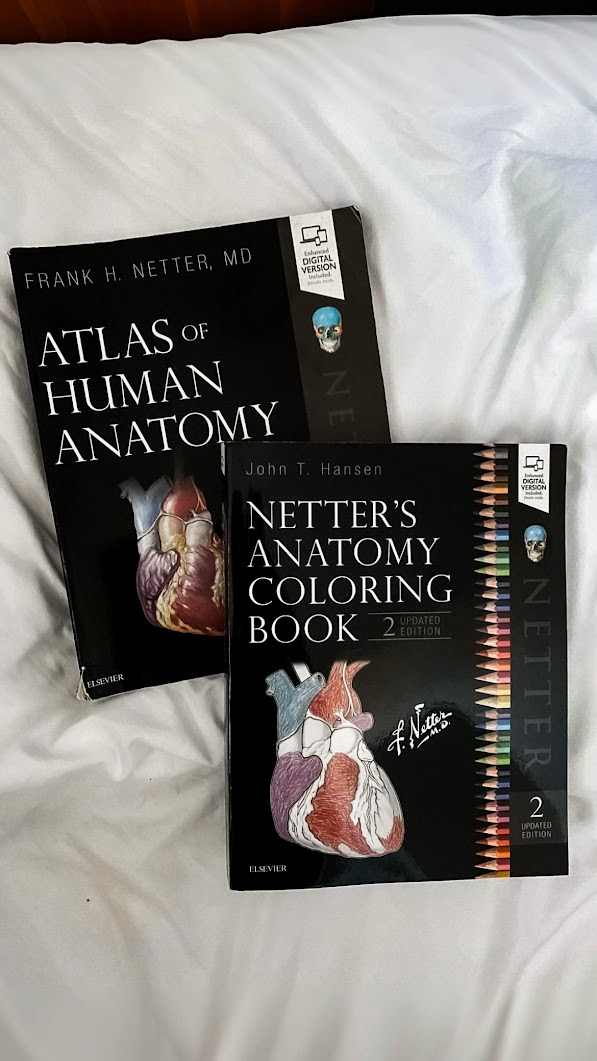
Over Summer 2024 I’ve had the pleasure of taking physiology (BIOL232). My experience with physiology may be a lot different then most. Since I’m taking the class during summer, it means we have less weeks in the quarter. To be exact we have 2 1/2 weeks less then usual which means we aren’t going as deep into physiology as we possibly could. I’m not sure if this has made it easier, or if physiology was just an easier class for me but I’ve thoroughly enjoyed it. The structure of this class is a lot different then anatomy. Instead of going over the basics or fundamentals you jump right into neurons at a microscopic level! The workload however is still heavy. Each week we read two-three chapters, which have two online assignments accompanying each chapter. We then have to watch a series of supplemental videos, and color five-seven pages in a VERY detailed physiology coloring book. When we head to in person lab, we do lectures with notes for the first hour, followed by a lab, a case study and then an exit quiz. We have a midterm and final, that are 100+ questions usually multiple choice and free response. Even though you don’t review the fundamentals you have to know them while taking this class. We discuss chemistry very often in this class with each new topic. The set up of this class works well with my learning style and Ill be finishing the quarter off with an A in the class.
My favorite part of this class is how much clinical relevance is involved with our learning. While anatomy feels like its trying to shove models down your throat, in physiology we answer medical based questions and apply our knowledge to pathologies and case studies. Some of the topics we went over in depth were, neurons, anesthesia, blood pressure, cardiac output (CO), stroke volume, ekg’s, blood sugar, hormones, respiration, edema, metabolism, starvation, etc. A lot of the labs we did were very fun, like blood typing ourselves, or running for 5 mins straight to see how CO works. In this class I sat next to my lab partner from anatomy. I cannot stress it enough how important it is to take classes with friends or create a study group. With a lab partner you can bounce ideas off of them, or ask clarifying questions. You can also work together and split up the workload on assignments.
As much as we all wanted to rip our hair out and cry during the quarter, I will admit that I enjoyed learning about the human body. There was always a part of me that felt kind of nerdy and excited to be learning about it. Knowing that with each new science class I was getting closer to the nursing school and closer to what I genuinely enjoyed learning about. The material and workload were hard but it is the foundation for your education in health care and I cannot stress it enough.
I only have one more class to take…microbiology! Ill be taking it in Fall 2024 and after I plan on applying to the nursing program!
 Amber Mckenzie
Leave a comment